Pilanesberg National Park
Pilanesberg National Park
Volcanic crater transformed into a reserve 3.5 hours from Johannesburg, Pilanesberg is home to the Big Five in a malaria-free zone.
Approximately 3.5 hours' drive from Johannesburg via Pretoria, Pilanesberg National Park occupies the eroded crater of a volcano that became extinct 1.3 billion years ago. This South African reserve, located in the North West Province, is home to the Big Five across a territory of ecological transition between the semi-arid Kalahari and the more humid Lowveld. Free from malaria risk and easily accessible, it makes a compelling choice for a first safari or to round out an itinerary in southern Africa.
Why visit Pilanesberg
The park combines several assets rarely found together: abundant wildlife including lions, elephants, leopards, buffalo and rhinoceros, accessibility from Johannesburg in half a day, and a malaria-free zone that makes it suitable for families. Its circular geology, inherited from an alkaline volcanic complex, creates concentric landscapes unique to southern Africa. Less crowded than Kruger, it offers quality wildlife viewing without the tourist pressure of major safari destinations.
Park history
The park bears the name of Tswana chief Pilane. Before its creation, the region was occupied by the Bakgatla tribe to the north and farmed to the south. In the 1960s, the apartheid government incorporated these lands into the Bophuthatswana bantustan. The park was officially established in 1979 and became the subject of Operation Genesis, a ten-year ecological restoration programme that dismantled agricultural installations, rehabilitated ecosystems and reintroduced dozens of species. This operation is now cited as a textbook example of large-scale rewilding. Pilanesberg now hosts the world's third-largest population of white rhinoceros, and has seen the return of wild dogs and lions.
What to see and do
Fauna and flora
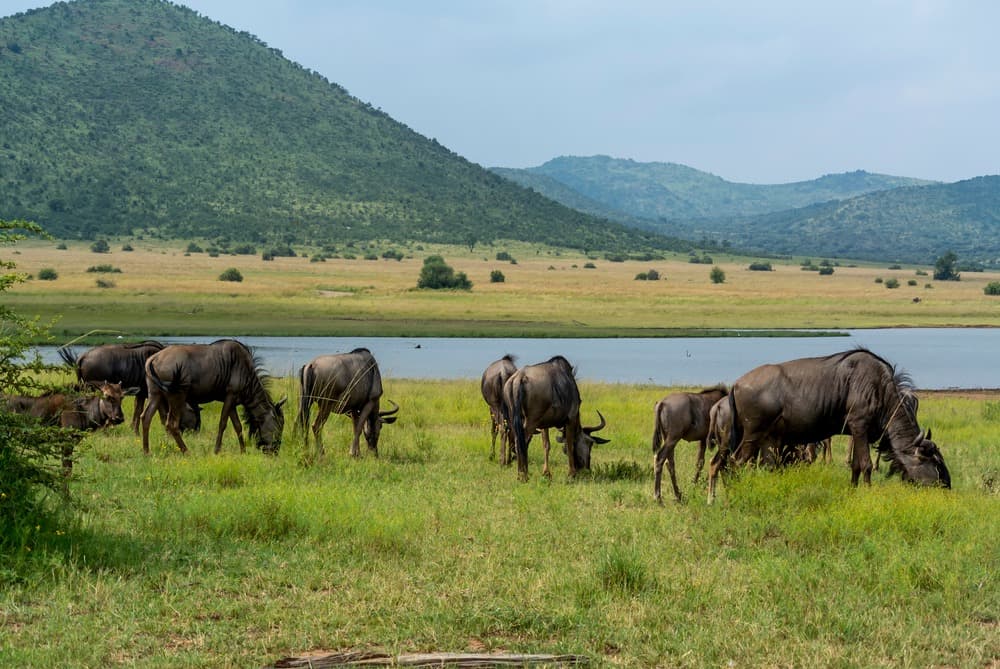
The park spans a transition zone between the Kalahari and Lowveld, explaining its diversity of habitats: hills, valleys, open savanna, dense thickets and rocky outcrops. The vegetation combines red willow, wild pear, buffalo thorn and large-leafed fig.
- Large mammals: Big Five (lion, elephant, leopard, buffalo, white and black rhinoceros), cheetahs, giraffes, zebras, hyenas, impalas, kudus
- Birdlife: over 360 bird species, mostly resident
Activities on offer
- Self-drive or guided safaris: the park can be explored in your own vehicle or by 4x4 with a guide. Six observation hides allow you to wait for wildlife near water points.
- Walking safaris: 4-hour walks led by an armed guide, accessible from age 16.
- Rhino tracking: in the private Letsatsing reserve, excursions allow you to locate rhinoceros via GPS signal and address poaching prevention issues.
- Hot air balloon flight at sunrise, with a bird's-eye view of the crater's circular structure.
- Walking trail and aviary at the Manyane complex, at the park's eastern entrance.
Practical information
Entrance fees remain moderate: an adult rate, a reduced child rate and a vehicle package. As prices are regularly reviewed, it's best to check current rates before your visit. Opening hours vary by season, generally from dawn to dusk, with wider time slots in summer than in winter. Confirm hours on the day itself, especially for an early morning safari departure.
Pilanesberg is located in a malaria-free zone, which simplifies logistics for travellers with children. Pack warm clothing for winter game drives, binoculars and a camera with telephoto lens.
When to visit
The park is open year-round. The dry season, from May to October, remains the most favourable period for viewing large mammals: vegetation becomes sparse, animals concentrate around water points and temperatures are cooler. The green season, from November to April, is better for birdwatching with the arrival of migrants and lush landscapes, but occasional rain can complicate some tracks.
How to get there
- By road from Johannesburg: allow approximately 3.5 hours via Pretoria. A raised vehicle is comfortable on some tracks, though a 4x4 is not essential.
- Organised transfers: private or shared shuttles from Johannesburg, usually included in lodge packages.
- By air: Pilanesberg airport, close to Sun City, is served by flights from Johannesburg and Cape Town. Check availability of connections at the time of booking, as the offer has evolved in recent years.
Nearby attractions
The Sun City leisure complex borders the park and offers hotels, golf, casino and water parks for a contrasting break. Further west, the Madikwe Game Reserve offers a more exclusive safari experience, also in a malaria-free zone. To extend your itinerary, Gorongosa National Park showcases another success story in ecological rehabilitation in southern Africa, and the Masorini archaeological site adds a cultural dimension to a regional circuit.
Frequently asked questions
Frequently asked questions
Extending the experience
Pilanesberg park fits naturally into a larger safari circuit. To build a bespoke itinerary, explore our southern Africa travel ideas.
Interested in this visit?
We can include it in your personalised itinerary.