Great Limpopo Transfrontier Park
Great Limpopo Transfrontier Park
A 35,000 km² transboundary reserve spanning Mozambique, South Africa and Zimbabwe: safaris, Big Five encounters and conservation at the heart of southern Africa.
In southern Africa, where Mozambique, South Africa and Zimbabwe converge, stretches one of the continent's most ambitious conservation projects: the Great Limpopo Transfrontier Park. This extraordinary territory brings together several emblematic protected areas to form a vast untamed wilderness without borders, where nature, wildlife and local cultures exist in harmony.
Designed as a coherent transboundary ecosystem, the park embodies a shared vision of biodiversity preservation and sustainable development. It invites you to discover an authentic Africa, where the freedom of movement for animals mirrors the landscapes, peoples and stories that traverse them.
The Birth of a Borderless Park
This park was born from a shared ambition among Mozambique, South Africa and Zimbabwe: to create a unified conservation zone that transcends political boundaries. The founding protocol was signed in November 2000 under the name Gaza-Kruger-Gonarezhou, before adopting its current name a year later.
Despite early setbacks due to diplomatic challenges, the project took shape in 2001: fences were removed, the first animal migrations resumed, and 40 elephants were transferred from Kruger Park to the Limpopo, launching a large-scale ecological rehabilitation. The opening of the Giriyondo border post in 2004 made this vision of a connected territory a reality.
A Living Project in Constant Evolution
Today, the Great Limpopo continues to expand. In 2017, the private Grande Lubombo reserve was integrated, further enlarging the protected perimeter. The park now connects numerous zones, both public and communal, such as the Sengwe lands in Zimbabwe or Makuleke in South Africa.
Driven by initiatives such as the Peace Parks Foundation, the park operates on collaborative governance involving states and local communities. It represents a regional model for sustainable conservation and shared development.
Wildlife and Flora of the Great Limpopo
The Great Limpopo is a jewel for nature lovers. Its biological richness unfolds through iconic wildlife and remarkable flora, adapted to diverse landscapes.
Emblematic Wildlife
- The Big Five: lions, elephants, rhinoceros, buffalo and leopards
- Notable Species: giraffes, zebras, blue wildebeest, hippopotamuses, spotted hyenas, cheetahs
- Rare Species: the African wild dog, naturally returned since 2010
- Dynamic wildlife sustained by migrations and natural resources
Varied and Distinctive Flora
- Shrubby savannas dominated by mopane and acacia trees
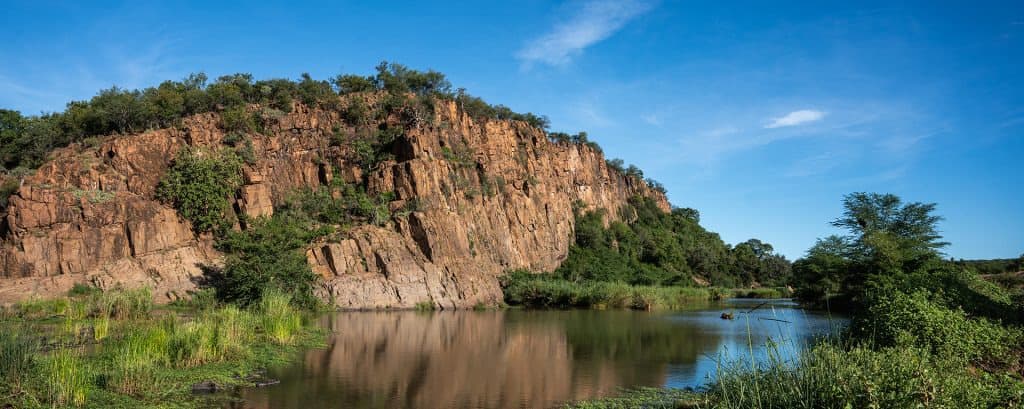
- Riparian forests along the Limpopo, Shingwedzi and Olifants rivers
- Floodplains rich in grasses, home to numerous species
- Sandy areas (sandveld) and rocky hills with specific vegetation
These habitats support nearly 2,000 plant species, along with a rich variety of birds, insects and reptiles.
What to Do in the Park?
Every activity in the park offers a sensory immersion into pristine nature, between wild sounds, changing landscapes and human encounters.
- Vehicle and Walking Safaris: explore the park's trails accompanied by local guides to observe animals in their natural habitat.
- Guided Hikes: traverse remote areas on foot, through forests, savannas and hills, learning to read the signs of wildlife.
- Birdwatching: nearly 500 species inhabit the rivers, plains and wooded areas of the park.
- Canoe Trips: on select stretches of the Limpopo, admire hippopotamuses, crocodiles and waterbirds.
- Community Encounters: discover villages and local projects connected to conservation.
When to Visit?
The park is accessible year-round, but April through September is ideal: milder climate, better wildlife visibility around water sources, and optimal conditions for safaris.
The park is accessible by road from neighboring countries:
- From South Africa: via the Giriyondo or Pafuri posts (Kruger Park)
- From Mozambique: via Massingir, 230 km from Maputo
- From Zimbabwe: via roads leading to Gonarezhou
A 4x4 vehicle is recommended for the Mozambican section. On the South African side, a standard car is sufficient for most routes.
The Great Limpopo spans multiple countries with varying travel conditions depending on the area:
- Giriyondo Route: facilitates passage between Mozambique and South Africa.
- 4x4 essential for the Mozambican section, with more challenging tracks.
- Standard vehicle sufficient on the South African side.
- 4x4 safaris and canoe excursions available through select lodges.
- Private guided tours offered for secure exploration.
Want to discover this destination?
Our local advisors design your tailor-made trip.